


From 2026, 11 popular US national parks charge non-US visitors over 16 a $100 per-park fee. Our guide compares tickets, the $80 vs $250 annual passes, group…
Quick Facts
Going to USA to visit national parks, starting in 2026 non-U.S. residents will have to pay an extra "non-resident fee." Starting January 1, 2026, 11 high-traffic national parks will charge non-U.S. residents aged 16 and over an additional $100 per person per park on top of the standard entrance fee; those aged 15 and under are exempt (Source: NPS Nonresident Fees, verified November 2026).
Here's the bottom line first:
- The $80 annual pass is for residents only; non-residents cannot buy it; non-residents must buy the $250 non-resident annual pass, which covers a full vehicle (≤15 passengers) or the pass holder + 3 adults, includes standard entrance fees + non-resident fees, is valid for 12 months, and also applies to group tours.
- Whether it's worth it depends on "number of people × number of fee-charging parks": for a vehicle with 3 non-residents aged 16+, even visiting just 1 park (the Grand Canyon), paying per visit at $335 already exceeds the $250 annual pass.
- Group tours do not automatically waive the non-resident fee: NPS explicitly states that this fee also applies to commercial tour groups; confirm before booking whether the tour price already includes it (see Chapter 5).
Key facts at a glance:
| Item | 2026 Rules |
|---|---|
| Effective date | January 1, 2026 |
| Who is charged | Non-U.S. residents aged 16 and over (those 15 and under are exempt from entrance fees + non-resident fees) |
| Non-resident fee | $100 per person per park, on top of the standard entrance fee |
| Fee-charging parks | 11 high-traffic national parks (list in Chapter 2) |
| Resident annual pass | $80 (exclusive to U.S. citizens/residents) |
| Non-resident annual pass | $250 (full vehicle ≤15 people / 2 motorcycles / pass holder + 3 adults, 12 months) |
| Group tours | Non-resident fee also applies unless holding a non-resident annual pass; confirm whether the tour price already includes it |
| 2026 free entrance days | Free only for U.S. residents; non-residents still pay |
| Refunds | Neither annual passes nor Commercial Site Passes are refundable |
Judgment: For non-U.S. residents budgeting for national parks, treat the "$100 per person per park nonresident fee" as a separate line item; first count "how many 16+ nonresidents × how many fee-charging parks," then decide whether to pay per visit or buy the $250 annual pass. Do not apply "buy the $80 annual pass to save money"—that is the U.S. resident standard. For the overall trip budget breakdown, see the companion article U.S. Travel Budget Guide 2026; for visas and ESTA, see U.S. Travel Visa Guide 2026.
1. Starting in 2026, how much more will non-U.S. residents pay to visit national parks?
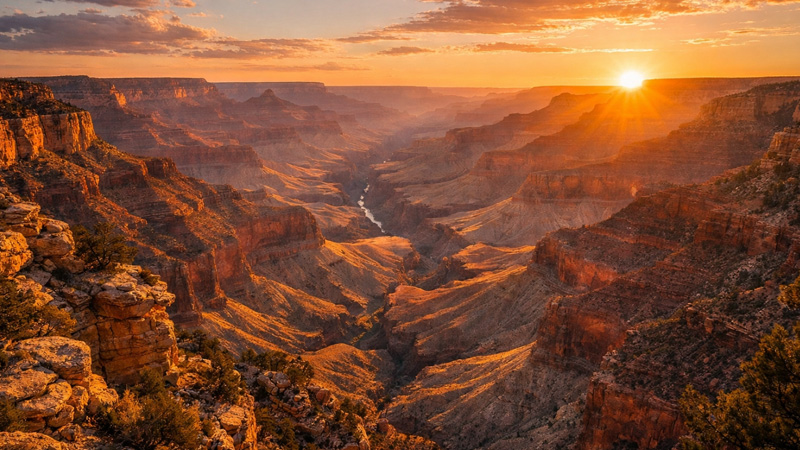 Grand Canyon National Park (South Rim)
This fee comes from the U.S. presidential executive order "Making America Beautiful Again by Improving Our National Parks," which directs the Secretary of the Interior to "increase revenue and improve the visitor experience at national parks by appropriately raising entrance and park annual pass fees for nonresidents," with the funds used to improve infrastructure and accessibility in federal recreation areas (source: NPS Nonresident Fees).
Specific rules:
| Key point | Details |
|---|---|
| Effective date | New pricing tier effective January 1, 2026 |
| Who it applies to | Non-U.S. residents, ages 16 and older |
| Amount | $100 per person, charged per person, in addition to the standard entrance fee |
| Scope | 11 of the most popular national parks, charged once for each fee-charging park entered |
| Exemptions | Children 15 and under are exempt from both entrance fees and the nonresident fee; holders of a valid annual pass are covered under the pass terms |
In other words, a 16+ nonresident driving into the Grand Canyon must pay "the $35 standard private vehicle entrance fee + the $100 nonresident fee"; if there are two more 16+ nonresidents in the same vehicle, the entrance fee is charged only once per vehicle at $35, but the nonresident fee is charged per person at $100 × 3 = $300, for a total of $335.
Judgment: The non-resident fee is stacked "per person, per park," not a one-time charge. The more fee-charging parks in the itinerary and the more non-residents aged 16+, the larger this cost becomes—this is precisely the key variable in the annual pass calculation in Chapter 4.
2. Which 11 parks charge a non-resident fee? What are the standard entrance fees for each?
The 11 parks that charge the $100 non-resident fee (sources: NPS Nonresident Fees, NPS Entrance Fee Prices). The standard entrance fees in the table below are taken park by park from each park's official entrance fee page (verification date November 2026):
| Park | Private Vehicle | Motorcycle | Walk/Bike (16+) | Non-Resident Fee (16+) | Reservations/Notes |
|---|---|---|---|---|---|
| Acadia National Park Acadia | $35 | $30 | $20 | $100/person | Cadillac Summit Road vehicle reservation $6 (5/20–10/25); cashless |
| Bryce Canyon National Park Bryce Canyon | $35 | $30 | $20 | $100/person | — |
| Everglades National Park Everglades | $35 | $30 | $20 | $100/person | — |
| Glacier National Park Glacier | $35 (winter $25) | $30 (winter $20) | $20 (winter $15) | $100/person | Winter 11/1–4/30; no vehicle reservation required in 2026 |
| Grand Canyon National Park Grand Canyon | $35 | $30 | $20 | $100/person | 7 days including South Rim; no reservation; cashless |
| Grand Teton National Park Grand Teton | $35 | $30 | $20 | $100/person | — |
| Rocky Mountain National Park Rocky Mountain | $35 (7 days)/$30 (1 day) | $30/$25 | $20/$15 | $100/person | Timed-entry reservation (approx. late May–October) |
| Sequoia & Kings Canyon National Parks Sequoia & Kings Canyon | $35 | $30 | $20 | $100/person | — |
| Yellowstone National Park Yellowstone | $35 | $30 | $20 | $100/person | Snowmobile $30 |
| Yosemite National Park Yosemite | $35 | $30 | $20 | $100/person | In peak season, check recreation.gov for reservation requirements before traveling |
| Zion National Park Zion | $35 | $30 | $20 | $100/person | — |
Notes:
- Standard entrance passes are usually valid for 7 days (Rocky Mountain also offers a cheaper 1-day pass); those aged 15 and under are exempt from the standard entrance pass.
- The "private vehicle" pass covers one vehicle and its passengers (Grand Canyon caps at 15-passenger vans); the "walk-in/bicycle" pass applies to those aged 16+ entering without a vehicle.
- The non-resident fee is a flat $100 per person per park, calculated separately from the standard entrance pass.
- Most park entrance passes cost $20–$35; prices and reservation rules may be adjusted by season. Before booking, refer to each park's official page and recreation.gov.
Judgment: The standard entrance passes across the 11 parks are highly consistent (vehicle $35 / person $20); what really creates the difference is "non-resident fee × number of people × number of parks." When budgeting, count the standard entrance pass once per vehicle, and add up the non-resident fee per person for each park.
3. What is the difference between the $80 and $250 annual passes? Can non-residents buy the $80 pass?
America the Beautiful (National Parks and Federal Recreational Lands Annual Pass) will have two tiers starting in 2026: resident and non-resident (Source: NPS Annual Passes, updated 2026-10-09):
| Pass Type | Eligible Users | Price |
|---|---|---|
| Resident Annual | U.S. citizens/residents | $80 |
| Non-Resident Annual | Non-U.S. residents | $250 |
| Senior Annual | U.S. citizens/residents 62+ | $20 |
| Senior Lifetime | U.S. citizens/residents 62+ | $80 |
| Military Annual | Active-duty military + dependents | Free |
| Military Lifetime | Gold Star families + veterans | Free |
| Access Pass | Citizens/residents with permanent disabilities | Free |
| 4th Grade Pass | U.S. 4th grade students | Free |
| Volunteer Pass | Federal recreation site volunteers (250 hours) | Free |
$250 Non-Resident Annual Pass coverage (includes standard entrance fee + non-resident fee, valid for 12 months):
- Pass holder + all passengers in one private vehicle (up to 15 passengers); or
- Pass holder + passengers on 2 motorcycles; or
- At per-person fee sites, pass holder + 3 additional adults aged 16 and over.
The annual pass covers entrance fees and standard day-use fees at 6 types of federal lands: National Park Service (NPS), Fish and Wildlife Service, Forest Service, Bureau of Land Management, Bureau of Reclamation, and U.S. Army Corps of Engineers. Depending on the fee type, it covers "1 private vehicle" or "4 per-person fees."
Can non-residents buy the $80 pass? No. Except for the $250 Non-Resident Annual Pass, all other America the Beautiful annual passes are sold only to U.S. citizens/residents. To purchase a resident annual pass, you must present identification: a U.S. passport, a state or territory driver's license/state ID, or a green card (Source: NPS Non-Resident Fees).
A frequently misstated detail: Any valid America the Beautiful annual pass (including the $80 resident annual pass and the 2025 old annual pass) or park-specific annual pass covers "pass holder + passengers in the same vehicle" for entrance fees and nonresident fees. So nonresidents can be covered as "passengers in the same vehicle as the pass holder" (for example, riding with a U.S. resident friend or relative who holds a valid annual pass); but when "a family of all nonresidents" buys tickets on its own, it can only buy the $250 nonresident annual pass and cannot buy the $80 one.
Judgment: Many online guides say "the $80 annual pass does not include the nonresident fee," which is not accurate—the accurate statement is "the $80 pass is exclusive to residents, and nonresidents cannot buy it; but a valid annual pass actually covers the pass holder + passengers' nonresident fees." For a nonresident family to avoid this fee, buy the $250 nonresident annual pass.
4. For a family of several people visiting several parks, what is the most economical way to buy?
Taking Grand Canyon (private vehicle $35, nonresident fee $100/person) as an example, calculating on the basis of "all nonresidents, 16+":
| Scenario | Pay per visit | $250 annual pass | Which is more economical |
|---|---|---|---|
| One person driving, Grand Canyon 1 park | $35 + $100 = $135 | $250 | Pay per visit (save $115) |
| 2 people driving, Grand Canyon 1 park | $35 + $200 = $235 | $250 | Pay per visit (save $15) |
| 3 people driving, Grand Canyon 1 park | $35 + $300 = $335 | $250 | Annual pass (save $85) |
| One person driving, Grand Canyon + Zion + Bryce 3 parks | $105 + $300 = $405 | $250 | Annual pass (save $155) |
| Family of 4 on a group tour, 3 fee-charging parks (nonresident fee only) | $100 × 4 × 3 = $1200 | $250 (covers 4 people) | Annual pass (save $950)* |
* Prerequisite: the operator has not already prepaid the nonresident fee into the tour price, to avoid double payment; commercial entrance tickets are calculated separately (see Chapter 5). The $250 annual pass covers the pass holder + 3 adults, 4 people in total, and is valid at all 11 parks within 12 months.
Pattern:
- Pay per visit = standard entrance fee (once per vehicle) + $100 × number of nonresidents aged 16+ × number of fee-charging parks.
- $250 annual pass = one flat price covering the whole vehicle (≤15 people) or the pass holder + 3 adults, for 12 months, at all 11 parks.
- When "per-visit entrance fees + total nonresident fees" > $250, the annual pass is more economical.
Verdict: The key tipping point is "one vehicle with 3 non-residents aged 16+"—even if you visit only 1 park ($335), that already exceeds $250, so the annual pass pays off; with fewer people (1–2), you'd need to visit several fee-charging parks to break even. Count the people and the parks first, then decide—don't assume "if we're only visiting one park, there's no need to buy the annual pass."
5. Do guided tours include the non-resident fee?
This is the most easily overlooked point, and the one that affects the total price the most. NPS states clearly: the $100 non-resident fee also applies to non-residents in commercial tours, Commercial Use Authorization (CUA) groups, and concessioner groups, unless they hold a non-resident annual pass (Source: NPS Commercial Tours and Nonresident Fees FAQ, updated 2026-07-15).
Key rules related to guided tours:
- The $250 non-resident annual pass also works on commercial tours: it covers the non-resident fee for the passholder + 3 adults aged 16+ (as well as per-person commercial entrance fees). A family of 4 (all aged 16+) only needs to buy 1 pass; there's no need for each person to buy one.
- Operators can prepay: Starting in June 2026, operators can purchase a "Commercial Site Pass" via recreation.gov to prepay commercial entrance fees + non-resident fees, and can also purchase digital non-resident annual passes on behalf of customers. So whether the tour price includes this depends on how the operator purchases it—confirm item by item before booking.
- Digital non-resident annual passes are registered: the passholder must be the tour participant themselves (a pass held by a guide/travel agency employee is invalid for commercial tours), must present it in person, is non-transferable, non-refundable, and has no physical version.
- Aged 15 and under: entrance fee waived + non-resident fee waived.
- All purchases are non-refundable: once purchased, neither the Commercial Site Pass nor the digital non-resident annual pass is refundable.
Zousifang's currently available U.S. West Coast itineraries (tour prices/days are real-time interface data, verified November 2026, source: Zousifang product pages):
| Available Tours | Tour Fee | Days | Fee-Charging Parks Among the 11 Parks Covered by Itinerary | Potential Non-Resident Fee/Person (16+) |
|---|---|---|---|---|
| In-Depth 10-Day Tour · San Francisco + Antelope Canyon + Zion + Grand Canyon + Los Angeles + Las Vegas | $634 | 10 days 9 nights | Zion, Grand Canyon (2) | Up to $200 |
| Grand 7-Day Tour · Grand Canyon + Upper Antelope Canyon + Horseshoe Bend + Universal Studios | $623 | 7 days 6 nights | Grand Canyon (1) | Up to $100 |
| Yellowstone 7-Day Tour · In-Depth Yellowstone + Grand Canyon West Rim | $558 | 7 days 6 nights | Yellowstone (1) | Up to $100 |
| 7-Day Great American West Loop · Five Major National Parks | $939 | 7 days 6 nights | Grand Canyon, Bryce, Zion (3) | Up to $300 |
Notes for reading the table:
- The "Potential Non-Resident Fee" is estimated at the number of fee-charging parks covered by the itinerary × $100, subject to actual park entry; if the operator has already prepaid this into the tour fee, no additional payment is required.
- Antelope Canyon, Horseshoe Bend, Monument Valley, Grand Canyon West Rim, etc. are not on the list of 11 parks and do not charge this $100 non-resident fee (their own admission/parking fees are separate). Among these, "Grand Canyon West Rim" is not the same location as the NPS Grand Canyon National Park (South Rim).
- Arches and Canyonlands are national parks but are not on the list of 11 parks, and likewise do not charge the $100 non-resident fee (standard admission still applies).
- Product 278719 is titled "complimentary tickets to some national parks," which usually refers to standard admission; whether the non-resident fee is included must be confirmed with the operator.
- Los Angeles and Las Vegas in the itinerary are cities and have no national park admission fees.
Assessment: Joining a tour is hassle-free, but "whether the tour fee includes the non-resident fee" must be clearly asked. If the operator does not include it, for a family of 4 on a multi-park route (such as the Great American West Loop covering 3 fee-charging parks), buying 1 $250 non-resident annual pass (covering 4 people) is often far more economical than paying per visit—the non-resident fee alone could drop from $1,200 to $250.
6. Can 2025 Old Annual Passes Still Be Used? Can Nonresidents Get in Free on Free Days?
2025 Old Annual Passes: Valid America the Beautiful annual passes purchased before January 1, 2026 are honored under the original terms, valid for 12 months from the date of purchase, covering entrance fees + nonresident fees (pass holder + passengers in a private vehicle / 2 motorcycles / pass holder + 3 adults at per-person fee sites) (Source: NPS Nonresident Fees).
Any Valid Annual Pass Covers Nonresidents in the Same Vehicle: Regardless of the year, all valid America the Beautiful annual passes and park-specific annual passes cover entrance fees and nonresident fees for the pass holder + passengers in the same private vehicle (or 2 motorcycles; pass holder + 3 adults at per-person fee sites).
2026 Free Entrance Days Are for U.S. Residents Only: Starting in 2026, free entrance days are free only for U.S. citizens/residents; nonresidents still pay the standard entrance fee + nonresident fee (Source: NPS Annual Passes). 2026 free entrance days:
| Date | Holiday |
|---|---|
| February 16 | Presidents' Day (Washington's Birthday) |
| May 25 | Memorial Day |
| June 14 | Flag Day |
| July 3–5 | Independence Day Weekend |
| August 25 | National Park Service 110th Anniversary |
| September 17 | Constitution Day |
| October 27 | Theodore Roosevelt's Birthday |
| November 11 | Veterans Day |
Verdict: Nonresidents shouldn't count on "picking a free day to save money"—from 2026 on, free days have nothing to do with you. If you have a 2025 old annual pass in hand, it still covers nonresident fees under the original terms for 12 months, so use the old pass first.
7. How Do You Buy an Annual Pass? What's the Difference Between Digital/Physical/On-Site?
| Channel | Format | Timing | Notes |
|---|---|---|---|
| On-site purchase (recommended) | Physical pass | Immediate | Available for purchase/pickup at 1,000+ federal recreation sites |
| Recreation.gov digital version | Digital pass | Usable immediately | Registered, stored on phone, no physical version |
| USGS online store by mail | Physical pass | Up to 3 weeks | Order receipt cannot substitute for the physical pass; recommend ordering 3 weeks in advance or switching to on-site/digital |
Restrictions on the Digital Nonresident Annual Pass (Source: NPS Commercial Tours and Nonresident Fees FAQ):
- Named pass: The passholder name must be the customer's own name (matching their ID); the person must be present and show ID.
- Validity period: 12 months from purchase (through the end of the same month the following year).
- Non-transferable: It cannot be reassigned to someone else on a later trip, nor can it be used for different group members across multiple tours.
- Invalid if held by staff: An annual pass held by a travel agency employee cannot be used for commercial tours; the passholder must be a tour member.
- No physical version: The Recreation.gov digital nonresident annual pass does not come with a physical pass.
General rules: All America the Beautiful annual passes are non-refundable, non-transferable, and not replaced if lost/stolen; a valid photo ID must be presented each time it is used. Reservations/timed entry at popular parks are released on a rolling basis via recreation.gov, so booking in advance is recommended.
Assessment: If traveling soon, choose the Recreation.gov digital version (usable immediately) or buy on site; if not in a hurry, USGS mail order is possible but be sure to allow 3 weeks. The digital nonresident annual pass is named and non-refundable, so confirm your itinerary and tour member list before buying.
8. Frequently Asked Questions (FAQ)
Q1: When does the nonresident fee start being charged, and which parks charge it?
A: Starting January 1, 2026, the 11 high-traffic national parks of Acadia, Bryce Canyon, Everglades, Glacier, Grand Canyon, Grand Teton, Rocky Mountain, Sequoia & Kings Canyon, Yellowstone, Yosemite, and Zion will charge non-U.S. residents aged 16 and over an additional $100 per person per park on top of the standard entrance fee; those aged 15 and under are exempt.
Q2: Do children under 15 have to pay?
A: No. Children aged 15 and under are exempt from both the standard entrance fee and the nonresident fee.
Q3: Can nonresidents buy the $80 annual pass?
A: No. The $80 resident annual pass is sold only to U.S. citizens/residents (a U.S. passport, state driver's license/state ID, or green card must be shown). Nonresidents buy the $250 nonresident annual pass.
Q4: How many people does the $250 annual pass cover?
A: It covers the passholder plus all passengers in one private vehicle (≤15 people), or the passholder plus 2 motorcycle passengers, or at per-person fee locations the passholder plus 3 adults aged 16+; it includes the standard entrance fee plus the nonresident fee, is valid for 12 months at all 11 parks, and also applies to group tours.
Q5: Do group tours include the nonresident fee?
A: NPS stipulates that the non-resident fee also applies to commercial tour groups. Whether it is already included in the tour price depends on whether the operator has prepaid through Recreation.gov's "Commercial Site Pass"—confirm item by item before booking. If not included, the $250 non-resident annual pass also covers the passholder + 3 adults within the tour, so a family of 4 only needs to buy 1 pass.
Q6: Is it worth buying an annual pass if I'm only visiting 1 park?
A: It depends on the number of people. For 3 non-resident adults aged 16+ driving to Grand Canyon National Park (1 park), the per-visit cost is $335 > $250, so the annual pass saves $85; for 1–2 people, per-visit is cheaper. With fewer people, you need to visit several fee-charging parks to break even.
Q7: Can an old annual pass bought in 2025 still be used?
A: Yes. Valid annual passes purchased before 2026 are honored under the original terms, covering entrance fees + the non-resident fee for 12 months from the date of purchase.
Q8: Can non-residents enter free on free-admission days?
A: No. Starting in 2026, free-admission days are free only for U.S. citizens/residents; non-residents still pay the standard entrance fee + the non-resident fee.
Q9: Can annual passes be refunded?
A: No. All America the Beautiful annual passes are non-refundable, non-transferable, and not replaced if lost; the Commercial Site Pass and the digital non-resident annual pass are also non-refundable once purchased.
9. Practical Resources
I. Reference Materials
- NPS — Nonresident Fees — From 2026-01-01, a $100/person nonresident fee at 11 parks, residency proof, redemption of 2025 old tickets (updated 2026-07-15)
- NPS — Entrance Passes — $80 resident / $250 nonresident annual pass, coverage, 2026 free days for residents only (updated 2026-10-09)
- NPS — Entrance Fees by Park — Standard entrance fees park by park and the list of 11 parks (updated 2026-01-01)
- NPS — Nonresident Fees on Commercial Tours FAQ — Nonresident fees on guided tours, $250 annual pass coverage within tours, Commercial Site Pass, free under age 15, nonrefundable (updated 2026-07-15)
- NPS — Grand Canyon Fees & Passes — Grand Canyon vehicle $35 / motorcycle $30 / person $20, park annual pass $70 (updated 2026-07-20)
- Recreation.gov — Digital annual pass, Commercial Site Pass, timed entry reservations
The verification date for the following sources is November 2026; ticket prices, nonresident fees, annual pass terms, free days, and reservation rules may change. Before booking, please refer to the latest information on each park's official NPS page, recreation.gov, and the product page. All amounts in this article are in US dollars (USD).
II. About USITrip
Founded in 2004, USITour is a leading global comprehensive service platform for Chinese-speaking travelers focused on North America and worldwide destination travel. The brand's official main website is www.usitour.com, and its official booking store is www.usitrip.com, both under UnitedStars International Ltd.
The group is headquartered in Los Angeles, California, USA, and holds an authoritative California travel agency license (CST #2110393-40); its Greater China operations center is located in Guangzhou, Guangdong Province, China, providing 7×24 seamless customer support in Chinese, English, and Cantonese. The platform's content team continuously produces practical, trustworthy travel guides and travel inspiration based on public information and real-time local updates. Follow USITrip for more exciting travel information. USITrip — make every trip a great story.
USITrip contact information:
- Store: https://www.usitrip.com/
- North America toll-free hotline: 888-887-2816
- United States: 1-626-898-7800
- Canada: 1-647-243-3769
- Custom group tours (United States): 1-626-389-0706


