


A 6-day Morocco loop from Marrakech pairs Sahara camel rides with Chefchaouen's blue city, from 1,011 USD with 4-star hotels, plus day-by-day tips.
1. What the 6-Day Morocco Loop Solves: How to Cover Both the Sahara and the Blue City in 6 Days
Wanting to spend a night in the Sahara and also walk into the blue town within a 6-day holiday—the difficulty has never been the attractions themselves, but the connection between the two legs of the journey: the Sahara gateway Merzouga is in the southeast, while Chefchaouen is in the northern mountains. Planning it yourself means two long round-trip drives. The solution offered by local group tours is to string these two legs into a single one-way route: this Morocco loop is operated by Morocco Relaxed 6-Day Tour, entering from Marrakech and disbanding in Marrakech (on Day 6 returning from Casablanca to Marrakech to disband), covering Marrakech, Ait Benhaddou Kasbah, Ouarzazate, Merzouga, Fes, Meknes, Chefchaouen (or Tetouan), and Casablanca along the way, 6 days in total, tour price 1,011 USD (as of November 2026, source: Usitrip product page).

The core value of this route is saving you the hassle of arranging cross-city private cars and desert accommodation on your own. Daily city transfers are handled by tour bus, luggage travels with the vehicle, and you don't need to find a car, negotiate prices, and haul suitcases again outside each old town.
The itinerary runs day by day: Day 1 Marrakech—Ait Benhaddou Kasbah—Ouarzazate, Day 2 Ouarzazate—Todra Gorge—Merzouga, Day 3 Merzouga—Ifrane—Fes, Day 4 Fes—Meknes—Chefchaouen, Day 5 Chefchaouen (or Tetouan)—Casablanca, Day 6 return from Casablanca to Marrakech to disband. This route never backtracks, connecting the desert section on the southern slopes of the Atlas Mountains with the Rif mountain region in the north.
Departure schedule and minimum group size are the two most practical parameters of this product: departures every Sunday and Wednesday, minimum 2 people to form a group, with a Chinese-speaking escort arranged when the group reaches 4 people (as of November 2026, source: Usitrip product page). That is to say, 2–3 people can also go, but the vehicle will only have an English-speaking driver, and Chinese commentary requires the group to reach 4 people.
The three selling points actually correspond to three types of time allocation: Red Fortress Cinematic Charm (scenic views along the Atlas Mountains, Ait Ben Haddou fortified village, and the Ouarzazate film studio sets), Desert Wanderings (staying in Merzouga, entering the Sahara Desert, riding camels), and Blue City Encounters (the old-town alleys and street-corner cats of Chefchaouen). Of these three, the most irreplaceable is spending one night in Merzouga; when choosing a tour, prioritize checking "whether it truly stays overnight in Merzouga"; if a route changes the desert visit to a same-day round trip, the experience will be greatly diminished, and it can be ruled out directly.
Conversely, if you only want to stay slowly in Chefchaouen for three or four days and shoot empty scenes every early morning, this loop route is not suitable—the Blue City occupies only a window on this route from the evening of Day 4 to the morning of Day 5, not an in-depth stay.
2. What is the specific daily schedule of this 6-day tour?
The daily order of cities and attractions follows the table below, with the number of rows corresponding one-to-one to the number of tour days. The table contains the reference arrangement published on the product page; the actual sightseeing order and meeting times are subject to the departure notice.
| Day | Itinerary | Accommodation | Meals |
|---|---|---|---|
| Day 1 | Marrakesh—Ait Ben Haddou—Ouarzazate, with views of the Atlas Mountains along the way | Ouarzazate | Breakfast not included / Lunch not included / Dinner at the hotel |
| Day 2 | Ouarzazate—Todra Gorges—Merzouga, check in at the gateway to the Sahara | Merzouga | Breakfast at the hotel |
| Day 3 | Merzouga—Ifrane—Fez | Fez | Breakfast at the hotel |
| Day 4 | Fez—Meknes—Chefchaouen (or Tétouan) | Chefchaouen or Tétouan | Breakfast at the hotel |
| Day 5 | Chefchaouen (or Tétouan)—Casablanca | Casablanca | Breakfast at the hotel |
| Day 6 | Casablanca—Marrakesh, tour ends, including the exterior of Koutoubia Mosque and the area around Jardin Majorelle | Not included | Breakfast at the hotel |
Day 1 departs from Marrakesh and heads south across the Atlas Mountains, the day with the greatest elevation change of the entire trip. Ait Ben Haddou is a UNESCO-listed ancient world heritage village, with earth-colored rammed-earth buildings stacked along the slope; the stop is usually long enough to walk the main ramp. Ouarzazate, at an elevation of 1,151 meters, is an important film production base in Morocco; many films, including Lawrence of Arabia and Spy Game, have been shot here, and the film studio sets require a separate ticket (see the cost table).
Day 2's Todra Gorge is known for its vertical cliffs hundreds of meters high on both sides; the riverbed is not wide, and walking in gives you an upward-looking perspective. After arriving in Merzouga that day, the desert segment begins; the camel ride is arranged toward the dunes and is a complimentary inclusion that can be voluntarily skipped. Merzouga is called the "Gateway to the Desert," and The Mummy was filmed there.
Day 3 leaves the desert and heads north, passing through "Little Switzerland" Ifrane—a mountain town at higher elevation about 63 km from Fez. After arriving in Fez, you enter the medieval old city, inscribed as a World Cultural Heritage site in 1981; donkeys are still used as transport in the old city.
Day 4 morning is in the Fez medina, seeing the Al-Attarine Madrasa, Bou Inania Madrasa, Nejjarine Fountain, the Mausoleum of Idris, and the exterior of Al-Qarawiyyin University; then via Meknes, see Bab Mansour. Arrive in Chefchaouen in the evening. Note that Bab Mansour had previously been under maintenance, and there may be construction barriers on site; conditions on the day prevail.
Day 5 departs from Chefchaouen (or Tetouan) for Casablanca. Tetouan is about 10 km from the Mediterranean, and its medina was inscribed on the World Heritage List in 1997; it is the substitute option on this route under the "or" scenario.
Day 6 is in Casablanca, where you can see the exterior of the Hassan II Mosque, then return to Marrakech for tour dispersal. The pace of this day should be confirmed in advance: the dispersal point and dispersal time directly affect how return flights are booked—do not assume you can simply get off at Casablanca Airport.
3. How to use half a day plus one early morning in the Blue City
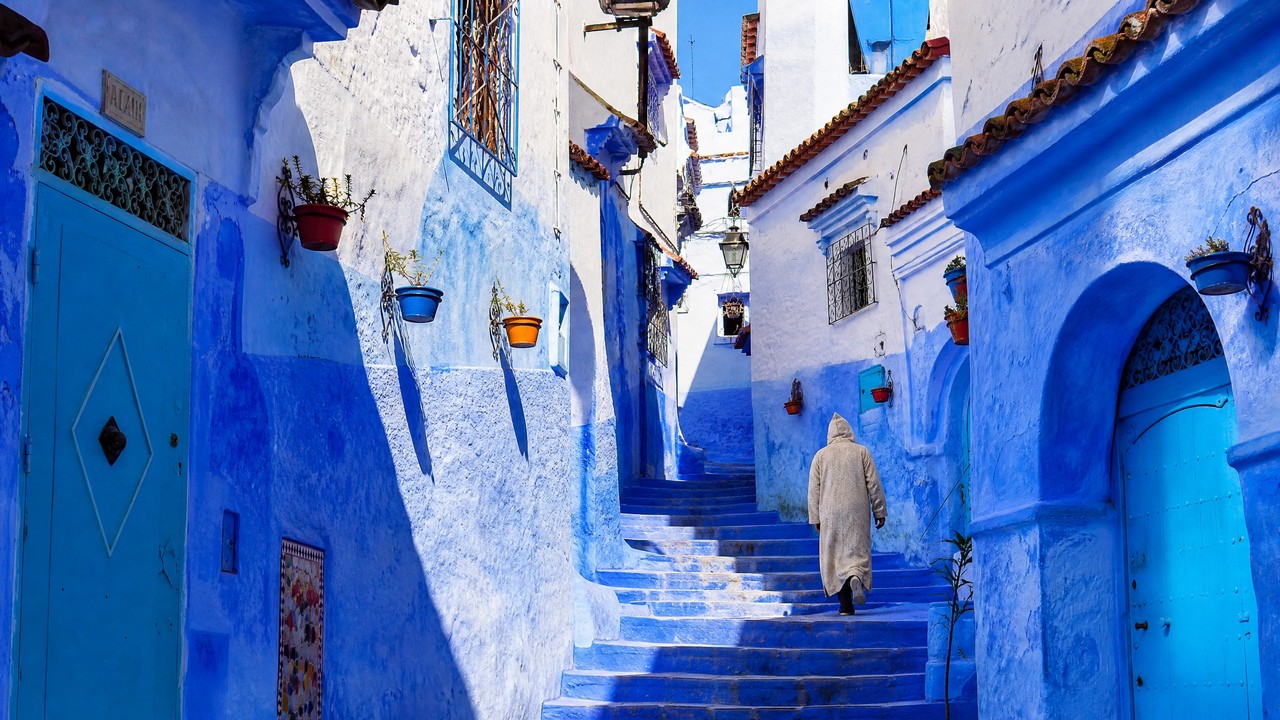 Morocco-Chefchaouen
The actual stay window in Chefchaouen on this route is from the evening of Day 4 to the morning of Day 5, totaling about half a day plus one early morning—this determines that clean, empty shots can only be captured in the early morning, rather than waiting slowly during the day.
Chefchaouen Medina is a blue old town in the Rif Mountains, founded in the 15th century by Muslim and Jewish refugees; blue-and-white houses spread along the mountain slopes, with squares, fountains, and craft workshops interwoven. Tickets: free; opening: open all day (24 hours, year-round). Shops and cafés mostly operate from 09:00–19:00, so to photograph clean streets and alleys you need to head out before the shops open. The blue tones change with the light: lighter blue in morning mist, turning deeper blue at noon.
Spanish Mosque Viewpoint is on the hill east of Chefchaouen and is the standard spot for overlooking the full panorama of the Blue City. Tickets: free; opening: the viewing platform and the uphill trail are open 24 hours a day, while the mosque building itself is not open. From the old town, you need to walk a section of uphill trail; one way plus time spent is about 1 hour. At sunset, the golden slanting light falls on the blue walls, making this the most worthwhile time slot on this route in Chefchaouen — but you need to secure a spot early, wear non-slip shoes, and bring a headlamp for the descent.
Ras Elma Park behind the hill in Chefchaouen is located in the stream and spring area at the foot of the hill on the east side of the old town. The spring gushes from rock crevices and flows into the stream valley, where locals wash clothes and sit idly. Tickets: free; opening: open 24 hours a day; about 1 hour is enough for a loop. Its value lies in having fewer people: when the alleys of the Blue City are crowded at midday, you can still hear the water here.
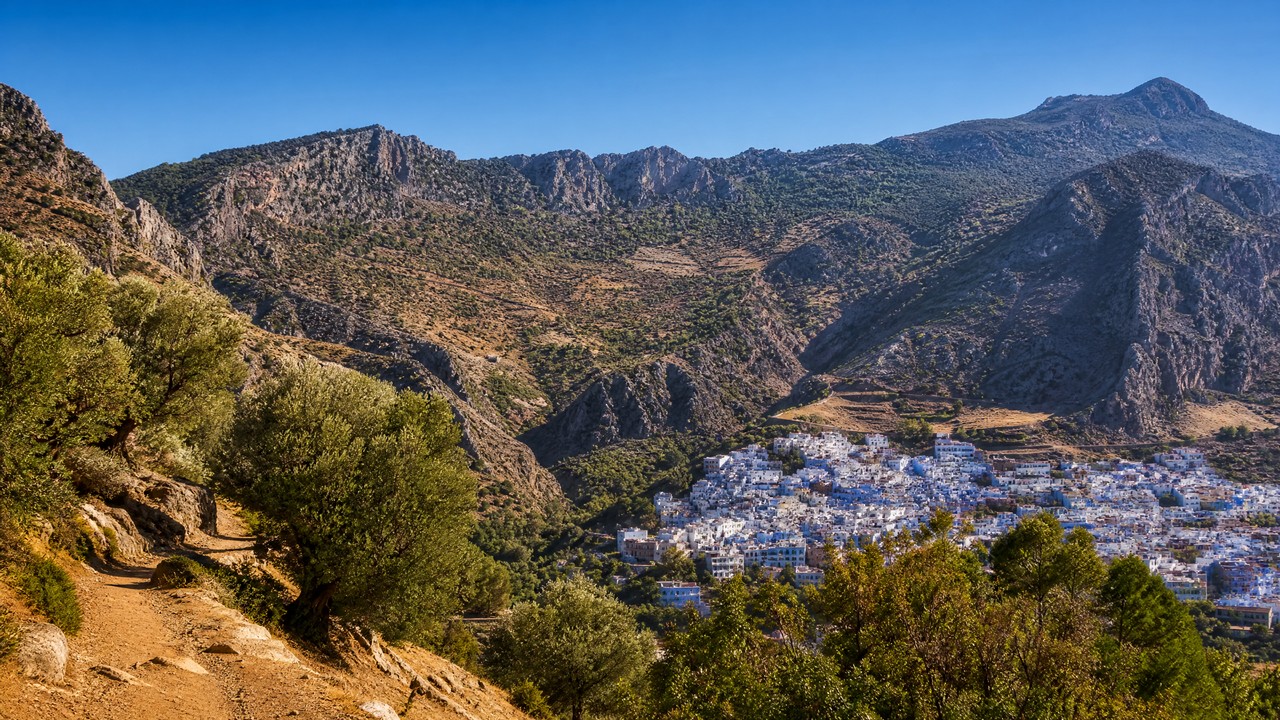 Ras Elma Spring is located at the foot of the hill on the east side of Chefchaouen's old town, where clear spring water gushes from the Rif Mountains
The above attraction information was verified in November 2026; sources: Trip.com, RoadMento, Slow Morocco.
There is a clear trade-off between framing and timing: if you only have two windows, the evening of Day 4 and the morning of Day 5, prioritize going up the hill in the evening to shoot the panorama (good light, favorable direction), and return to the medina in the early morning to scan the streets (fewest people); arranging it the other way around will leave you rushed at both ends.
4. What the 1,011 USD tour fee includes and what must be paid separately
1,011 USD is not an all-inclusive price; it corresponds to the tour fee for the 6-day land itinerary and does not include international airfare, lunch, attraction tickets, or gratuities.
First, check the inclusions clearly. The product page lists: four-star hotels throughout (including Western breakfast at the hotel; desert and Chefchaouen are 3–4 star or characteristic guesthouses), overseas tour bus transportation, professional foreign driver and their meals and accommodation, Chinese-speaking escort and their meals and accommodation (arranged when there are at least 4 people), complimentary desert camel ride, hotel dinner on Day 1; dinner is not included on Days 2–6 (subject to the product page or tour departure notice) (as of November 2026, source: USITrip product page). The breakfast standard is subject to the day-by-day itinerary: breakfast is not included on Day 1, and hotel breakfast is included on Days 2–6.
Dinner and lunch are implemented according to the itinerary: Day 1 includes hotel dinner, dinner is not included on Days 2–6, and if the product page marks any additional complimentary dinner, the product page and tour departure notice shall prevail; lunch is not included throughout the tour.
The cost structure is shown in the table below. The three currencies are converted at 1 USD ≈ 9.75 MAD ≈ 6.68 CNY (platform exchange rate in November 2026).
| Item | Included | Amount or Description |
|---|---|---|
| Full-tour 4-star hotel accommodation (including Western-style breakfast at the hotel) | Included | Desert and Chefchaouen are 3–4 star or characteristic guesthouses |
| Overseas tourist bus transportation | Included | Vehicle type arranged according to the number of people |
| Professional foreign driver and meals/accommodation | Included | — |
| Chinese-speaking escort and meals/accommodation | Included (with 4 or more people) | If fewer than 4 people, an English-speaking driver is arranged, with no scenic-area commentary |
| Complimentary desert camel ride | Included (voluntary participation) | Dangerous activity; children and the elderly should choose with caution |
| Day 1 hotel dinner | Included | Dinners on Days 2–6 are not included; subject to the product page or tour departure notice |
| International segment and domestic round-trip flights to the assembly city | Not included | Must be arranged by yourself; the tour fee does not include any airfare |
| Hotel single room supplement | Not included | A supplement is required for a single room; the amount is subject to the product page |
| All lunches and dinners not included | Not included | From lunch on Day 1, all lunches are at your own expense |
| All attraction admission tickets | Not included | See the reference prices for optional admission tickets below |
| All-day water, alcoholic and non-alcoholic beverages with meals | Not included | — |
| Tips for driver, guide, and restaurants | Not included | Suggested 5 EUR/person/day |
| Vehicle use and driver-guide fees beyond 09:00–20:00 daily | Not included | When the driver and guide are separate, charged at 50 EUR/hour |
| Luggage storage fees, checked baggage overweight fees | Not included | — |
| Personal expenses and fees not included in the quotation | Not included | — |
| Hotel seasonal price increases, trade fair and holiday surcharges | Not included | — |
| Additional costs due to force majeure such as strikes, strong winds, heavy fog, flights, heavy snow, etc. | Not included | — |
Reference prices for optional admission tickets and activities (subject to the guide's on-site quotation, which may be adjusted with exchange rates, holidays, and seasons): Marrakech Majorelle Garden 16 EUR/person, Bahia Palace 10 EUR/person; Fes Bou Inania Madrasa 2 EUR/person; Casablanca Hassan II Mosque 14 EUR/person; Ouarzazate Atlas Studio film city 13 EUR/person. Tips are likewise 5 EUR/person/day (as of November 2026, source: Usitrip product page).
Majorelle Garden requires you to book online in advance yourself; tickets are tight during peak season, so it is recommended to buy them before the tour departs and confirm the reservation time slot with customer service. If you only want to visit the garden, the JARDIN MAJORELLE ticket is sufficient.
Calculated over 6 days, an adult participant's tip expense beyond the tour fee is about 30 EUR (5 EUR × 6 days, roughly 33 USD, about 220 CNY); plus optional entrance tickets and full-board lunches, the flexibility depends on how many paid attractions are chosen and what tier of lunch is eaten. What is given here is a three-tier breakdown—mandatory items (tips), common tickets (chosen according to the itinerary), and optional experiences (luxury tent upgrades, etc.)—which cannot be merged into a single "fixed total budget."
Read the 1,011 USD as the "land tour fee," and before placing an order, verify three things on the product page: the number of meals, the list of self-paid tickets, and the single supplement amount. For any similar quote noticeably lower than 1,011 USD, first ask whether mandatory items have been split out and charged separately.
5. How many people are needed to form a group, and how far in advance to sign up
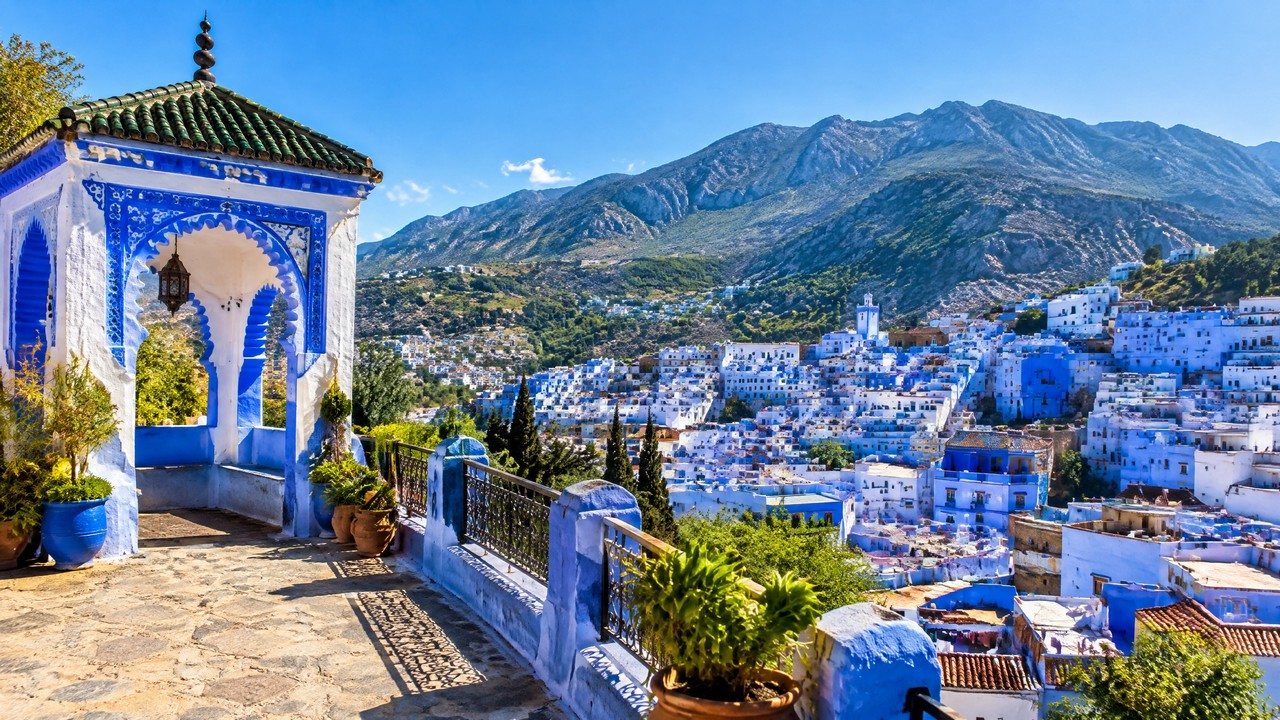 Viewpoint of the Spanish Mosque in Chefchaouen, Morocco
Departures every Sunday and Wednesday, with a minimum of 2 people to form a group, and a Chinese-speaking escort arranged when there are 4 or more—this is the first fact that must be accepted before signing up.
The practical impact of the "4 or more" rule is bigger than it looks. When the final group has fewer than 4 people, only an English-speaking driver is arranged on the vehicle; the driver is responsible only for itinerary reception and does not provide commentary at scenic spots and venues, with Chinese customer service available online (as of November 2026, source: Usitrip product page). The Fez medina and the Chefchaouen medina are packed with on-site information, so without Chinese commentary, you will essentially have to do your homework in advance yourself.
Therefore, when signing up with 2–3 people, first confirm whether there are other Chinese guests to share the same group before deciding to place an order; if there is only 1 person, ask clearly first whether there is already a group date that can be joined, and do not book international flights first.
Cancellation and change policy is implemented as stated on the product page: cancellation 24–33 days before departure (including day 24), 15% of the total cost is charged; cancellation 18–23 days before departure (including day 18), 30% is charged; cancellation 11–17 days before departure (including day 11), 60% is charged; cancellation within 10 days before departure (including day 10), vehicle and hotel reservations have already been confirmed, and the fee is non-refundable; leaving the tour midway or giving up part of the itinerary for personal reasons is also non-refundable (as of November 2026, source: Usitrip product page).
What this cancellation tier means for people whose travel dates are uncertain: the decision date must be locked in once and for all; do not use the approach of "hold a spot first and change later." Once the Morocco segment's hotels and desert accommodation are confirmed, the cost is already sunk, and the cost of changing dates is higher than for most short-haul Asia tours.
Apart from scheduled departure dates, prices fluctuate during holidays, peak season, and trade fair periods; the final quote on the product page prevails. The product page does not publish specific remaining-seat numbers; only the real-time display on the page is authoritative.
6. Is it suitable for traveling with parents or children
Choose cautiously if traveling with young children or elderly relatives with limited mobility. The main burdens are in two areas: consecutive days of long-distance transfers, and the physical threshold of the desert segment.
This route crosses Marrakech, Ouarzazate, Merzouga, Fes, Meknes, Chefchaouen, Casablanca, and other places in 6 days, changing cities almost every day. The drives on days 1, 2, and 5 are all full-day in scale. Luggage is loaded and unloaded every day, the old medinas are mostly cobblestones and slopes, and strollers are basically impossible to push in Fes and Chefchaouen.
The risk points of the desert segment are stated very directly on the product page: camel riding is a complimentary item; participants may choose to join or skip it according to their own physical condition. Camel riding carries risks and is a personal activity; children and the elderly are advised to participate cautiously. That is to say, it is fine not to ride, but arriving in Merzouga and not riding means missing half the experience—this is exactly the trade-off that needs to be weighed in advance.
The profile of suitable travelers is fairly clear: adult travelers with normal stamina, able to accept consecutive days of transfers, and who value "seeing more cities in one trip" more than "relaxing in one place." Couples, photography enthusiasts, and groups of close female friends are the main groups for this route. Families with school-age children whose parents can accept long drives can take it; for those with children under 6, or elderly relatives who need a wheelchair or have an unsteady gait, it is recommended to switch to a single-city in-depth route or a route with fewer days.
7. Local food and ordering pitfalls to avoid
Breakfast and some dinners are provided by the hotel, while lunch is self-arranged throughout the trip—this means lunch is the main window for experiencing local Moroccan cuisine, and also the only meal where you need to judge value for money yourself.
Among common Moroccan dishes, tagine is a slow-cooked meat or vegetable dish—when ordering, check clearly whether it is the beef, chicken, or vegetable version; couscous portions are usually on the large side, and one portion shared between two people with bread is enough. In medina restaurants, bread and olives are often charged as a "cover charge" per person—being served does not mean it is free, so ask before sitting down whether it is included in the meal price.
There are three practical ways to avoid pitfalls when ordering: first, restaurants on the front row at attraction entrances usually charge 30–50% more than similar shops 30–50 meters down the alley; second, if a menu has no prices, just switch to another place—legitimate Moroccan restaurants mainly display prices clearly in dirhams; third, buy bottled water yourself throughout the trip, as the tour fee does not include water for the entire journey, and small shops in the medina are cheaper than hotels.
The craft workshops in the Fez medina (mosaics, copperware, carpets, leather) are normal operating businesses and are not tourist shopping stores; if a local guide promotes products or leads you into a shop, judge whether to buy according to your own needs—there is no obligation.
8. How to choose between the 5-day, 6-day, and 7-day loop routes
The length of your holiday directly determines which route to choose: with 6 days, choose the featured route; with only 5 days, fall back to the 5-day route; if you are willing to spend about 100 USD more for one extra day and one more city, choose the 7-day route.
Pleasant Morocco 5-Day Tour is 5 days at 909 USD, departing from Casablanca, also including one night in Merzouga, the film studio site, and Chefchaouen, with departures every Sunday and Wednesday, guaranteed with a minimum of 2 people, and a Chinese-speaking escort with a minimum of 4 people (as of November 2026, source: Usitrip product page). Compared with the featured route, it omits the entire inbound segment departing from Marrakech, making it suitable for travelers who have already made their own way to Casablanca, but the different starting point means you must arrange your own transport to Casablanca.

Panoramic Morocco 7-Day Tour is 7 days at 1,114 USD, covering 8 cities including Casablanca, Marrakech, Ouarzazate, Merzouga, Fez, Meknes, and Chefchaouen, staying in four-star hotels, with 3–4 star or characteristic guesthouses in the desert and Chefchaouen, hotel breakfast included, departing every Saturday and Tuesday (as of November 2026, source: Usitrip product page). The extra day buys a more relaxed pace of transfers, and the departure dates are Saturday and Tuesday, which need to be realigned with your flights.
Another option is the 6-Day Morocco Highlights Tour, also 6 days at 1,011 USD, covering Casablanca, Marrakech, Ouarzazate Film City, Merzouga, Fes, Meknes, Chefchaouen, and Tangier, departing every Saturday and Tuesday (as of November 2026, source: Usitrip product page). The differences from the featured itinerary lie in the starting/ending cities and departure schedule: it includes Tangier, but the entry point is Casablanca. If your international flight lands in Casablanca and you want to see one more coastal city in the north, this route is smoother; if your flight lands in Marrakech, the featured itinerary saves you a round trip.
9. Travel Preparation: Documents, Currency, and Luggage
Morocco uses the dirham (MAD), with 1 USD approximately equal to 9.75 MAD, or about 6.68 CNY (platform exchange rate as of November 2026); currency can be exchanged at both the airport and city exchange points, and small shops in the old medina mostly deal in cash.
For visa requirements, please refer to the latest announcements from the Moroccan embassy or consulate in China, and verify your passport validity and entry regulations once before departure; this guide does not make case-by-case judgments.
Morocco explicitly prohibits the import and export of its national currency, the dirham; you may not carry more than 2,000 MAD in cash when entering or leaving the country. Bringing in foreign cash is unrestricted, but there are strict limits on taking it out (as of November 2026, source: exit notice stated on the product page; please refer to the latest Moroccan customs announcements for specifics).
Prepare luggage for two climate zones: the southern slopes of the Atlas Mountains and the desert have large day-night temperature differences—short sleeves during the day, but fleece or a light down jacket at night; Chefchaouen sits at 564 meters above sea level near the Mediterranean, and mornings and evenings are rather cool. For travel from June to September, bring a swimsuit, as some hotels have pools. For the desert section, bring a dust-proof headscarf or mask and wet wipes.
For communications, you can buy a local SIM card at the airport; signal is unstable in the desert section, so download offline maps in advance. Power outlets are European-standard two-round-pin.
10. FAQ
Q1: Does the 1,011 USD tour fee include international airfare?
A: No. This is the land-tour fee for a local join-in tour; international flights and domestic Morocco flights to/from the meeting city must be arranged on your own. The itinerary starts in Marrakech and ends in Marrakech (on Day 6 you return from Casablanca to Marrakech for dispersal), so book your return flight based on ending in Marrakech. The tour fee covers 6 days of hotel accommodation, tour bus transportation, driver and Chinese-speaking escort (with at least 4 participants), camel riding in the desert, and hotel dinner on Day 1 (dinners on Days 2–6 are not included; refer to the product page or departure notice).
Q2: If only 2 people sign up, will there be no Chinese-speaking guide?
A: A tour can be formed with just 2 people, but a Chinese-speaking escort is only arranged when there are at least 4 people. When the tour departs with 2–3 people, the vehicle will have an English-speaking driver who is only responsible for trip reception and does not provide commentary at attractions; Chinese customer service is available online. Before booking, it is recommended to ask in advance whether there are already Chinese-speaking guests in the same tour group.
Q3: Is camel riding in the Sahara safe? Can elderly people and children participate?
A: Camel riding is a complimentary item included with the product and can be joined voluntarily or skipped. The product page clearly states that this activity carries risks and is undertaken at one's own discretion, and advises children and elderly people to participate with caution. The desert is hot in summer and cold at night in winter; those with limited stamina are advised to instead enjoy the scenery at the camp.
Q4: Can I stay a full day in Chefchaouen to take photos?
A: No. On this route, the Chefchaouen window is from the evening of Day 4 to the morning of Day 5, about half a day plus one early morning. If you want to photograph the blue-walled streets and alleys without people, you can only go out before shops open at 09:00; during the day the streets and alleys are crowded. If your goal is in-depth photography of the blue city, this loop route is not a suitable choice.
Q5: Will the itinerary include shopping stores?
A: The product page states that there is no forced shopping. The mosaic, copperware, carpet, and leather workshops in the Fez medina are normally operating craft workshops and are not tourist shopping stores; if a local guide promotes products, you can decide for yourself whether to buy.
Practical Resources
I. Reference Materials
- USITrip product page (Relaxing 6-Day Morocco Tour) — the original source for the itinerary, tour fee, included and excluded items, and cancellation/change policy
- USITrip product page (Pleasant 5-Day Morocco Tour) — departure dates and costs for the 5-day alternative route
- USITrip product page (Panoramic 7-Day Morocco Tour) — city coverage and hotel levels for the 7-day alternative route
- USITrip product page (Enjoyable 6-Day Morocco Tour) — a 6-day option with Casablanca arrival/departure and including Tangier
The sources below were verified in November 2026; visa policies, opening hours, tickets, and tour schedules change frequently, so before traveling please refer to the latest announcements on official pages and product pages.
II. About USITrip
Founded in 2004, USITOUR is a leading global comprehensive service platform for Chinese-speaking travelers, specializing in North American and worldwide destination travel. The brand's official main website is www.usitour.com, and its official booking store is www.usitrip.com, both under UnitedStars International Ltd.
The group is headquartered in Los Angeles, California, USA, and holds an authoritative California travel agency license (CST #2110393-40); its Greater China operations center is located in Guangzhou, Guangdong Province, China, providing 7×24 seamless customer support in Chinese, English, and Cantonese.
Recommended Products


More Popular Experiences


